
How Arrest Warrants Work in Houghton County
Michigan Court Rule 6.101 sets the ground rules. The complaint must be written, must identify or describe the accused, must state the offense and its statute, and must be signed and verified. Rule 6.102 then lets the court issue an arrest warrant or a summons once probable cause appears. The paperwork can come from several hands. It might be the sheriff, a city police department, or the state police, with the prosecuting attorney taking part in the charging decision. The Houghton County prosecutor's office sits on the third floor of the courthouse. Call before you visit. Felony files often start in district court. They move to circuit court after a bindover. One case can carry a district number early and a circuit number later. So ask Houghton County which number fits before you chase the warrant.
How Probable Cause Reaches a Houghton County Court
Probable cause is a reasonable factual basis. It must support two beliefs: that an offense occurred and that the named person committed it. It can rest on the complaint itself, on a supporting affidavit, or on sworn testimony given to a magistrate. MCL 764.1a sets the standard for issuing a warrant or a summons on a proper complaint. Michigan generally prefers a summons over an arrest warrant. Exceptions exist. An assaultive or domestic violence allegation, a reason to think the person will not appear, a public safety risk, or a prosecutor's request can tip the balance toward a warrant. The magistrate's power to sign rests on written authorization. The state benchbook for district court magistrates spells it out. Michigan Court Rules, Chapter 6 carries the complaint, warrant, summons, and release rules a Houghton County court applies. That chapter shows the exact procedure for a Houghton County warrant or summons.
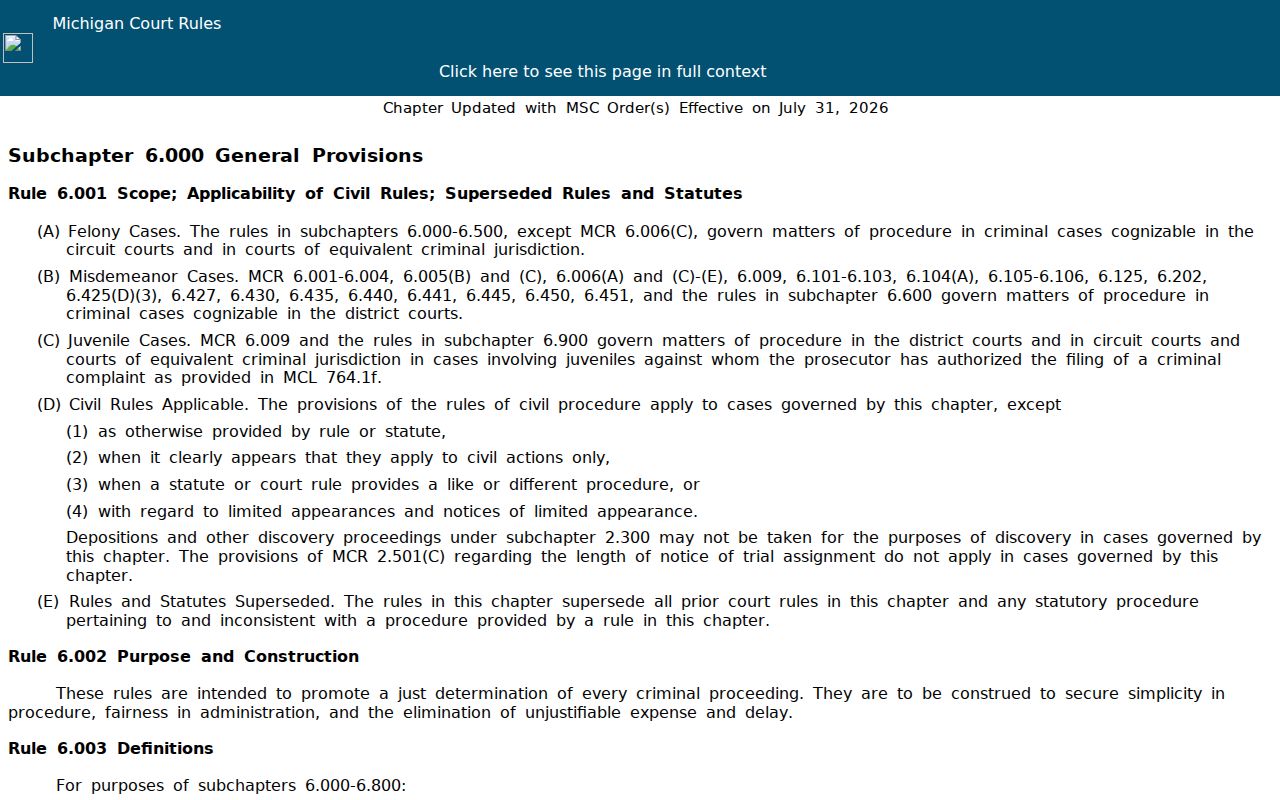
Those rules set out what a Houghton County court must have in hand before a judge signs a warrant.
Arrest Warrants: What They Contain
Michigan law lists what the document must carry, and the return tells the court what happened when an officer acted on it. Houghton County publishes no sample warrant. So the statutory framework, not a local listing format, fills the gap. Ask the clerk which fields the file actually shows.
| Case number | The court-assigned identifier for the district or circuit file. |
|---|---|
| Named or described subject | The person the warrant identifies or describes, per MCL 764.1b. |
| Charge and statute | The alleged offense and its citation, taken from the complaint. |
| Issuing judge or magistrate | The judicial officer who authorized the warrant. |
| Command to an officer | The direction to bring the person before a judicial officer. |
| Bond and return | Any release condition set and the officer's filing after service. |
An arrest warrant is not a search warrant. Houghton County treats them as separate documents. A search warrant authorizes a search of a place or thing, and its supporting affidavit stays nonpublic for 56 days under the state access chart. Never treat one as proof of the other.
97th District Hearings and 12th Circuit Bindover
A felony case in Houghton County usually starts with a complaint. It is filed in the 97th District Court, where the district judge or magistrate handles the arraignment and the preliminary examination. At that hearing the prosecutor presents evidence that a crime occurred and that the defendant likely committed it. Probable cause found at that stage changes everything. The case is bound over to the 12th Circuit Court, which serves Houghton, Baraga, and Keweenaw counties. From then on the circuit court controls the docket. A circuit clerk or recorder answers questions about the file. That handoff explains a common confusion. The same person may hear two case numbers within a few weeks. Ask which court holds the case before you ask about a warrant, since the answer changes the office you call in Houghton County.
How Warrants Get Served in Houghton County
An authorized peace officer executes the warrant. The return then goes back to the court. In Houghton County that officer may come from the sheriff's office, a city police department, the Michigan State Police Calumet Post, or another agency assigned to the case. Service can happen anywhere. A traffic stop, a residence, a workplace, or a visit on unrelated business can all end in an arrest. Afterward the person is booked and brought before a judicial officer for arraignment and a release decision under Michigan Court Rule 6.106. Houghton County publishes no policy on service attempts. Nor does it publish rules on calling first or transporting an out-of-county warrant. Treat any specific claim about those steps as unsourced.
Sheriff, City Police, and State Police Roles
The sheriff's office is the countywide agency. It patrols 1,044 square miles and 14 townships, handles criminal enforcement and investigations, and provides court officers, transports, and bailiffs. City and village departments handle their own jurisdictions. State police cover areas without a local department. South Range has no village police department and gets sheriff service. Calumet's department was disbanded in 2018, so the state police and the sheriff respond there. Houghton County has no constable office or city marshal office, so an assignment can land with any authorized peace officer. Ask which agency investigated the case. Then ask the issuing court which agency holds the warrant. The two answers are not always the same agency.
Arrest Warrants, Summonses, and Bench Warrants
Three papers can pull a person into a Houghton County courtroom. Each one demands something different, and mixing them up sends you to the wrong counter with the wrong idea of what happens next.
| Feature | Arrest Warrant | Summons | Bench Warrant |
|---|---|---|---|
| What it orders | Custody and a court appearance | An appearance on your own | Custody for a missed obligation |
| Basis | Probable cause of an offense | A charge that does not need custody | Failure to appear or comply |
| Who issues it | A judge or magistrate | The court on the complaint | The judge handling the open case |
| How to respond | Attorney, surrender, or bond | Show up on the date | Appear or seek a recall |
Michigan rules lean toward a summons first. That is why some Houghton County charges start with a court date rather than a warrant.
Ask the Court Before Choosing a Surrender Location
No Houghton County office runs a walk-in warrant window, an after-hours surrender desk, or a fixed ID rule for turning yourself in. So call first. A phone call beats a long drive to Houghton every time.
- Call the issuing court and confirm the charge, the case number, and whether a warrant is open.
- Ask whether a voluntary appearance under Michigan Court Rule 6.105 applies and whether a lawyer should file first.
- Ask where a surrender should happen and during which hours, then confirm the entrance before you go.
- Ask whether a bond has been set, and confirm the amount and the accepted payment route with the court.
For custody and bond logistics, Corrections takes calls at 906-482-1742. The sheriff's office is 906-482-0055. Neither one can change what a court has ordered.
Handling an Arrest Warrant in Your Name
You have three ways to resolve an arrest warrant: appear voluntarily, post bond, or file a motion to recall or quash it. A Michigan attorney helps with all three. The full set of steps sits on the Houghton County warrant records home page. It covers confirming the issuing court, reaching counsel, and following the court's instructions on where to appear.
Important: talk to a lawyer before turning yourself in. An open warrant can lead to arrest at a traffic stop or any contact with law enforcement.
Do not skip the court call to save an hour. One missed instruction on where to appear can add a whole extra hearing to your Houghton County case.
Federal Arrest Warrants Outside Houghton County
Federal warrants live in a different world. Houghton County belongs to the Northern Division of the Western District of Michigan, and a federal warrant never shows up in a Michigan state court search. Clearing a state case will not touch one either. Marquette serves as the reporting location for the Northern Division, and the district court there answers at 906-226-2021. The Western District of Michigan lays out its structure and court locations, while the district's CM/ECF information page carries the case-number format, hours, and PACER contact details. Federal case numbers follow their own pattern. Never apply that format to a Michigan state file.
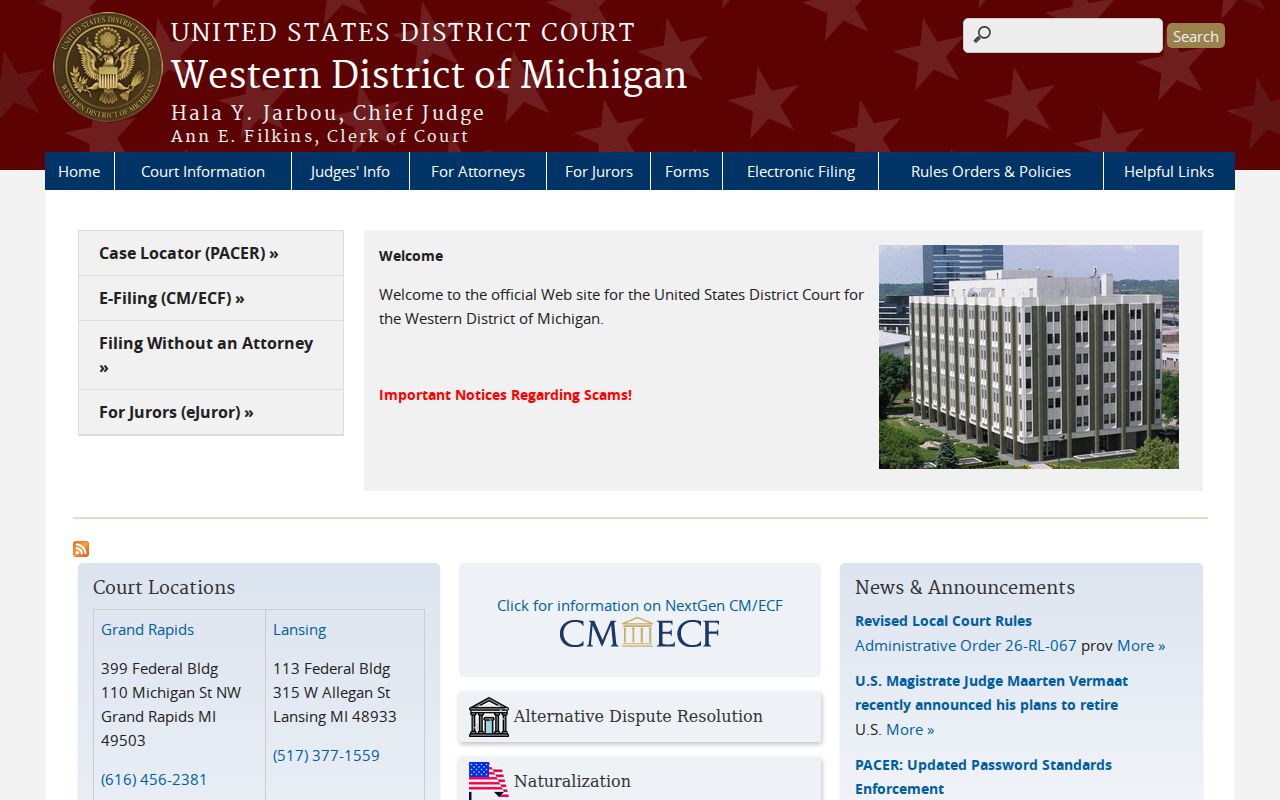
The federal layer runs on its own system. The Marquette court is the entry point for this region. PACER is the public route to federal case records, though you need a registered account to search it. The U.S. Marshals Service covers Houghton County from the same district and runs a federal fugitive tip program separate from any county most wanted list.
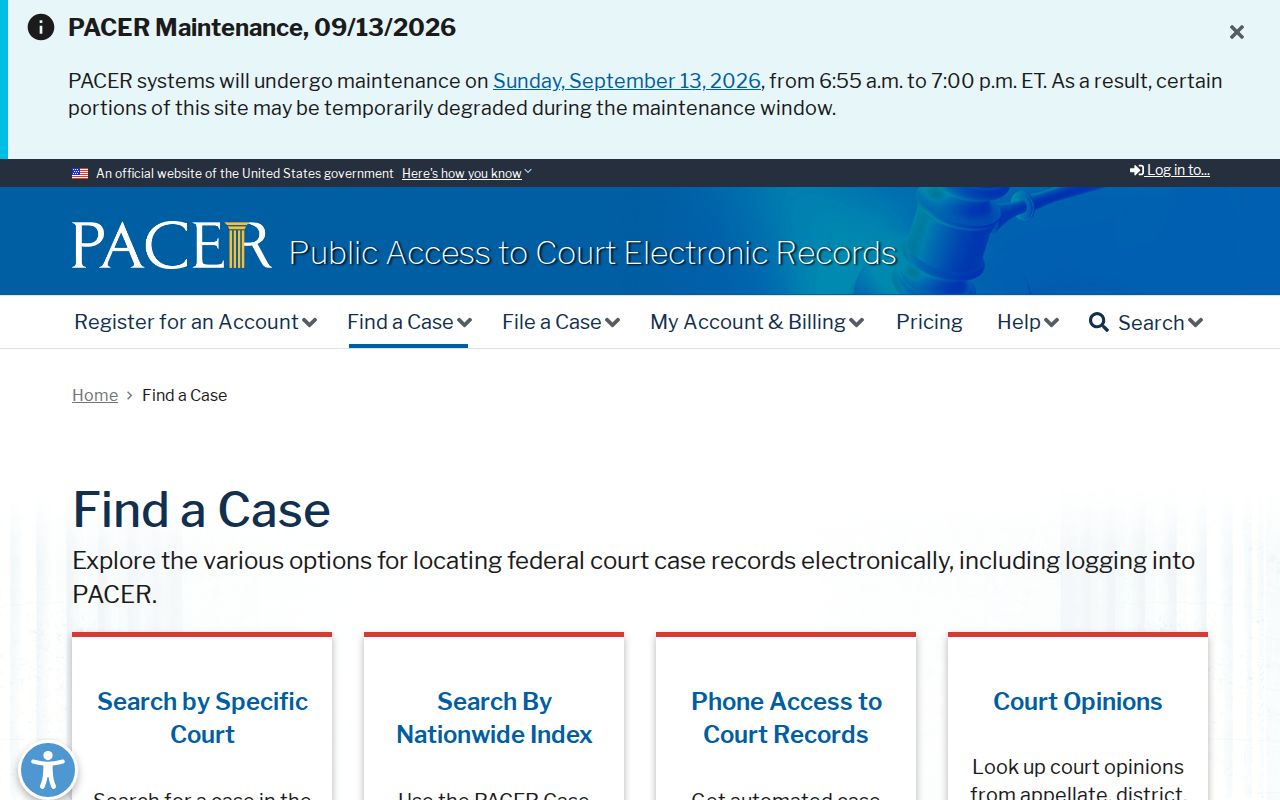
Even a registered search can miss sealed or restricted federal entries. Call the court directly when the question is urgent, because that Houghton County case file will not show it.